
How to Search for Osceola County Warrants
No official portal lists every active warrant for the county. That fact shapes the whole search. You build the answer from a few public tools. Start with the court case search, since a warrant or capias often shows as a docket event once the case is public. Then check the daily arrest report and the current inmate search to see if the person was already booked. If you still need a yes or no, call the court division or the law-enforcement agency for official word.
Pick the tool that fits what you know. Have a case number? Go straight to the court portal. Only have a name? You can still search, but common names bring many hits. Worried someone was just arrested? The arrest report and inmate search update fast.
- Search the court case portal by name or case number.
- Open the case and read the docket for a capias or warrant entry.
- Check the daily arrest report for recent bookings.
- Run the current inmate search in case the person is in custody.
- Call the court or the Osceola County Sheriff to confirm an active warrant.
Verify before you act. A docket entry can be old, cleared, or recalled. Only the court or the agency can confirm a warrant is still live.
Types of Osceola County Warrants
Not all warrants mean the same thing. The word covers a few different court orders. Some send police to arrest a person. One sends them to search a place. Knowing the type helps you read a docket and plan the right move. The list below breaks down the main kinds you may meet in an Osceola County warrant search.
- Arrest Warrant
- A judge issues this when a sworn complaint shows probable cause that a person committed a crime. It orders police to take the person into custody.
- Bench Warrant
- This comes straight from the bench, meaning the judge. It often issues when a person fails to appear or disobeys a court order.
- Capias
- A capias is an arrest writ. Courts use it often for failure to appear or for contempt. It works much like a bench warrant in practice.
- Search Warrant
- This order lets law enforcement search a named place for named items. It does not order an arrest by itself.
A capias and a bench warrant both push a missed step back in front of the court. An arrest warrant starts from a fresh charge. A search warrant is a tool of an investigation, not a personal command to surrender.
Note: A capias and a bench warrant can both lead to arrest. If you missed a hearing, do not wait for police to find you. Contact the court or counsel first.
What an Osceola County Warrant Record Shows
When a warrant ties to a case, the data lives in court and jail systems. You will not see a clean warrant printout. Instead you read the pieces from a docket or a booking page. These fields tell you who, what charge, what bond, and which case it links to. The table maps the common fields drawn from local court and corrections pages.
| Field | What It Shows |
|---|---|
| Name / ID | Person named, plus an inmate or arrest ID when booked |
| Booking Number | Jail booking reference if the person was taken in |
| Statute | Florida statute number and a short charge description |
| Charge Description | Plain text of the offense, such as a probation violation |
| Bond | Amount set per charge, which can be zero on a hold |
| DSP Date | Disposition or status date tied to the charge |
| JSTAT | Jail status code used by corrections |
| Reference Case | The court case number, such as 2014 CF 003321 |
| Arresting Agency | The agency shown on the daily arrest report |
Some daily report entries even read "OUT OF COUNTY (FL) WARRANT." That tells you the hold came from another Florida county, not Osceola.
Using the Daily Arrest Report and Inmate Search to Spot Osceola County Warrants
The daily arrest report is one of the best free clues for warrant work. It lists people booked into the Osceola County Jail each day. Each row shows a name, a mugshot, an arrest number, a booking number, and a statute with charge text. A warrant arrest will show up here once the person is booked. The report has a date selector that goes back several weeks. You can also open a printable version or download an Excel file.
The current inmate search works alongside it. It lists people held in the jail right now. Inclusion does not mean guilt. The data updates several times a day, and released people drop off at the next update. So if a name shows in the inmate search, a warrant may already have been served.
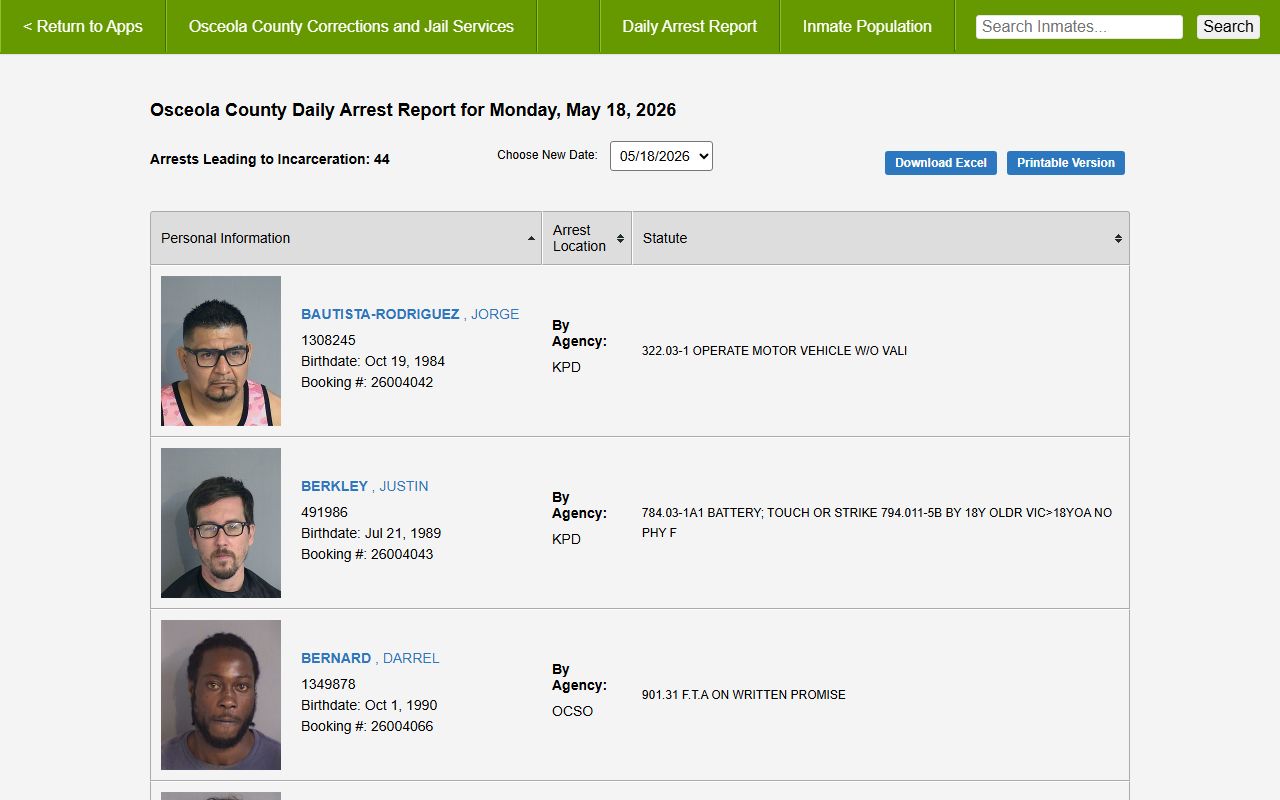
The daily arrest report above shows the date picker and the statute column you scan for warrant arrests. For names already held, the inmate search page walks through the booking detail fields.
Note: An arrest report shows a booking, not a finding of guilt. Charges can change or be dropped. Read it as a lead, not a verdict.
Why Osceola County Has No Single Warrant Portal
Many people expect a search box that returns every open warrant. Osceola County has no confirmed public tool like that. Warrants move through different systems before they reach the public. A warrant may sit with a judge, a clerk, or a law-enforcement agency. Active warrants can stay out of public view while police try to serve them. So the data spreads across the court docket, the jail report, and agency wanted notices.
This split is normal for Florida counties. It protects active cases and keeps police work from being tipped off. For you, it means no shortcut. You gather the pieces and confirm with the source. The court can speak to a case warrant. The Sheriff and other agencies handle service. When in doubt, ask the office that holds the record. That is the only way to be sure a warrant is real and still open.
What to Do If You Have an Outstanding Osceola County Warrant
Finding your own name in a warrant search can feel scary. Stay calm and act with care. Do not ignore it, since a warrant does not expire on its own. The smart first step is to confirm the warrant is real through the court or the agency. Then talk to a lawyer before you do anything else. Counsel can explain bond, the charge, and how to surrender in a planned way that limits surprise.
Bond eligibility depends on the warrant type, the charge, and the judge. A missed-hearing capias may clear once you appear and the court resets the case. A new criminal charge is more serious. Either way, a planned response beats a roadside arrest. After the matter is resolved, check the court docket to make sure it updated. Also confirm there is no lingering driver-license hold or probation issue left open.
- Confirm the warrant with the court or law enforcement.
- Talk to a lawyer before you appear or surrender.
- Ask about bond and how to address it.
- Check the court docket after resolution.
Search Warrants and How They Work
A search warrant is a different animal from an arrest warrant. It does not order anyone to surrender. Instead it lets law enforcement search a named place for named things. A judge signs it after a sworn showing of probable cause. The warrant must describe the place and the items with care. Florida law also limits how long police have to carry it out.
Under Fla. Stat. § 933.07, a search warrant must be executed within the time the statute sets. If it is not served in time, it goes stale. Records tied to a search warrant can later appear in a criminal court file. The return on the warrant and any seized-item list may become part of the case once it is public.
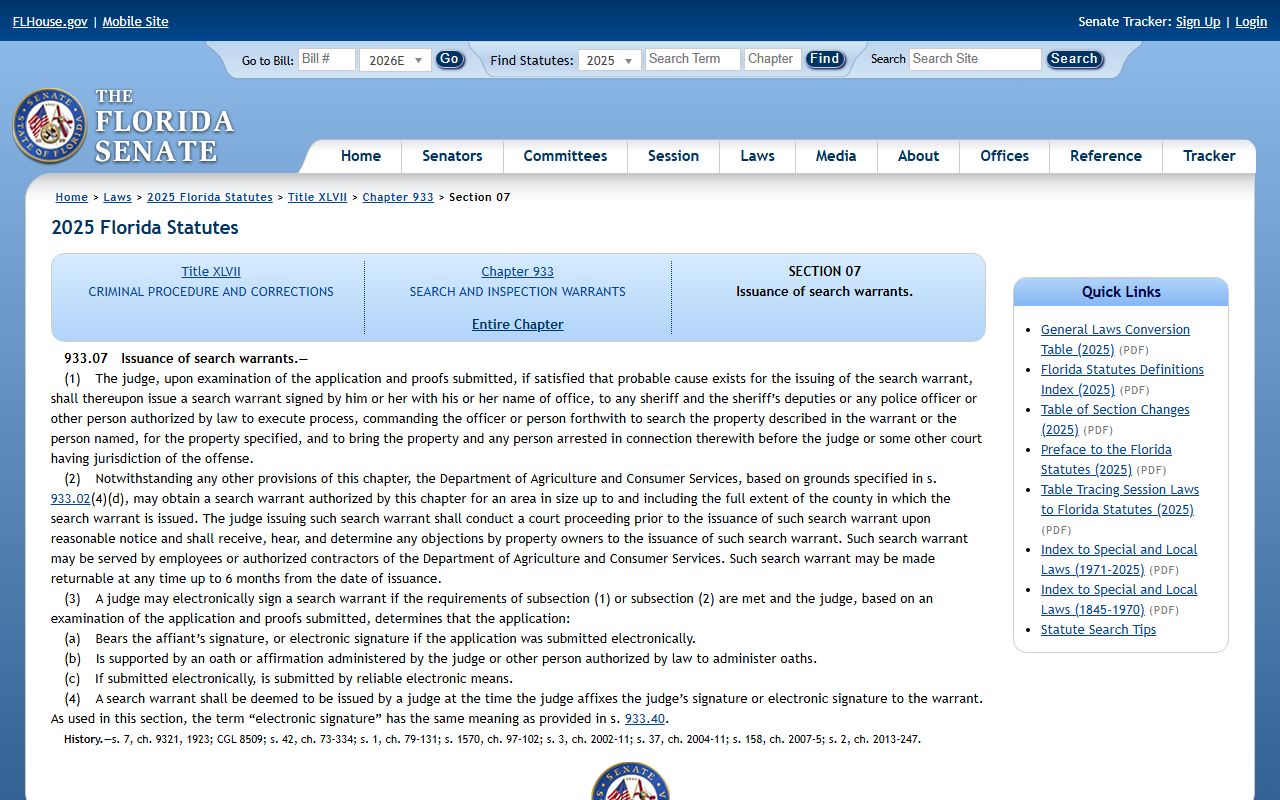
The search warrant statute shown above sets the execution rules. You can read the related case file later through the court records portal.
Warrant Laws in Florida That Apply in Osceola County
Florida statutes set the rules for both arrest and search warrants. They guide when a warrant may issue and how it must be carried out. Osceola County courts follow the same state code as the rest of Florida. Reading the law helps you understand what a warrant in your case can and cannot do.
For arrest warrants, Fla. Stat. § 901.02 says a warrant may issue when a complaint shows probable cause that a crime was committed. A judge or magistrate reviews the sworn complaint first. For search warrants, the § 933 chapter governs the grounds and the steps, with § 933.07 covering execution and time limits.
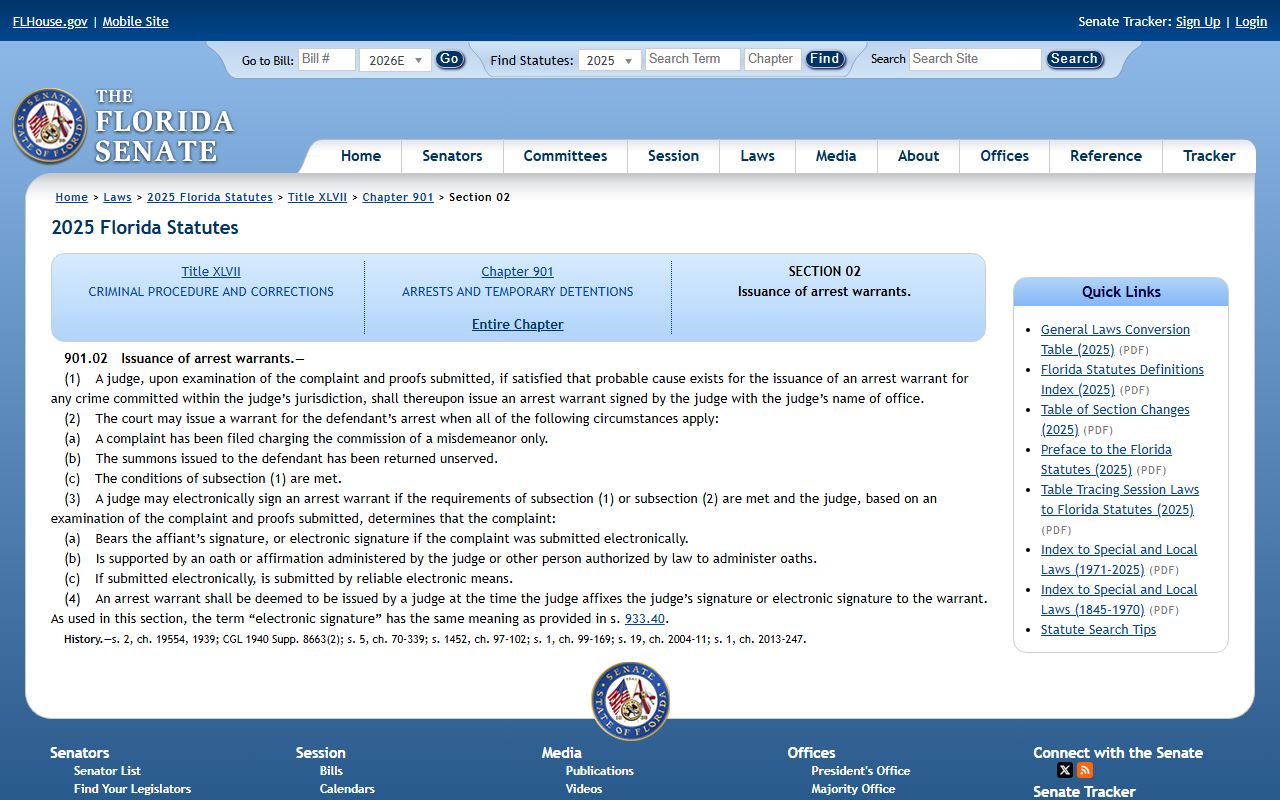
The arrest warrant statute above sets the probable-cause standard. These rules apply to every warrant handled in the county's courts.
Avoiding Third-Party Warrant Sites
A web search for warrants brings up many private sites. Most promise instant results for a fee. Be careful here. These sites are not official, and their data is often old, wrong, or scraped from public pages you can read for free. They cannot confirm an active warrant, and some exist mainly to harvest your name and payment.
Warning: Do not rely on third-party or aggregator warrant sites. They are not official and may show stale or false data. Use only the court portal, the jail reports, and the official court or law-enforcement offices to confirm any Osceola County warrant.
The free official tools beat any paid lookup. The court case search, the daily arrest report, and the inmate search are run by the county and the Clerk. If those do not answer your question, the next step is a phone call to the office that holds the record, not a credit-card form on a stranger's website.