
How to Find Recently Released Osceola County Inmates
Start with one key fact. The Osceola County public inmate search only lists people in custody now. When someone is released, the system removes them during the next update. So the jail roster is not a history file. It will not show a person who left last week. This trips up a lot of people. You search a name, get no hit, and think the search broke. More often, the person is just gone from the live list.
That changes how you confirm a release. You cannot rely on the jail search alone. You use it to learn one thing: is the person still in custody or not? If a name shows up, the person is in. If it does not, the person may be out, moved to state prison, or held by another agency.
The Daily Arrest Report fills part of the gap. It lists bookings by date. It will not say when someone got out. But it can confirm a recent booking and give context like the charge and booking number. That helps when you know roughly when a person was taken in. From there, you pick the right release tool based on where the case went.
Here is the full workflow to verify a release in Osceola County. Follow the steps in order.
- Search the current Osceola County inmate population by name. A hit means the person is still in custody.
- No result? The person may have been released at the next update, or moved to another agency.
- Need booking context? Check the Daily Arrest Report by date for the charge and booking number.
- For a state prison sentence or supervision, search the FDC inmate population and release tools.
- For victim notification on any custody change, use VINELink Florida and register for alerts.
- For federal custody, use the BOP Inmate Locator.
Most people only need one or two of these. A county misdemeanor case stays at the county level. A state felony sentence moves to the FDC. The steps below break down each tool.
Setting Up Release Notifications (VINELink)
VINELink is the official Florida victim notification system. It lets you register for alerts on an offender's custody status. You can get a call, an email, or a text when something changes. That covers a release, a transfer, or other key events where the data is supported. For many people, this is the simplest way to learn about a release without checking a roster every day.
VINELink is built for victims, but the search is open to the public. You pick the state, then search by person or offender details. When the system supports it, you register a contact and set up alerts. You do not have to watch the jail page. The system reaches out to you.
Register early if a release date matters to you. Notifications depend on the data the source agency feeds in. So set up your contact info and test it. Keep your phone and email current. If your number changes, update it in the system or you may miss an alert.
The VINELink Florida search page is shown below.
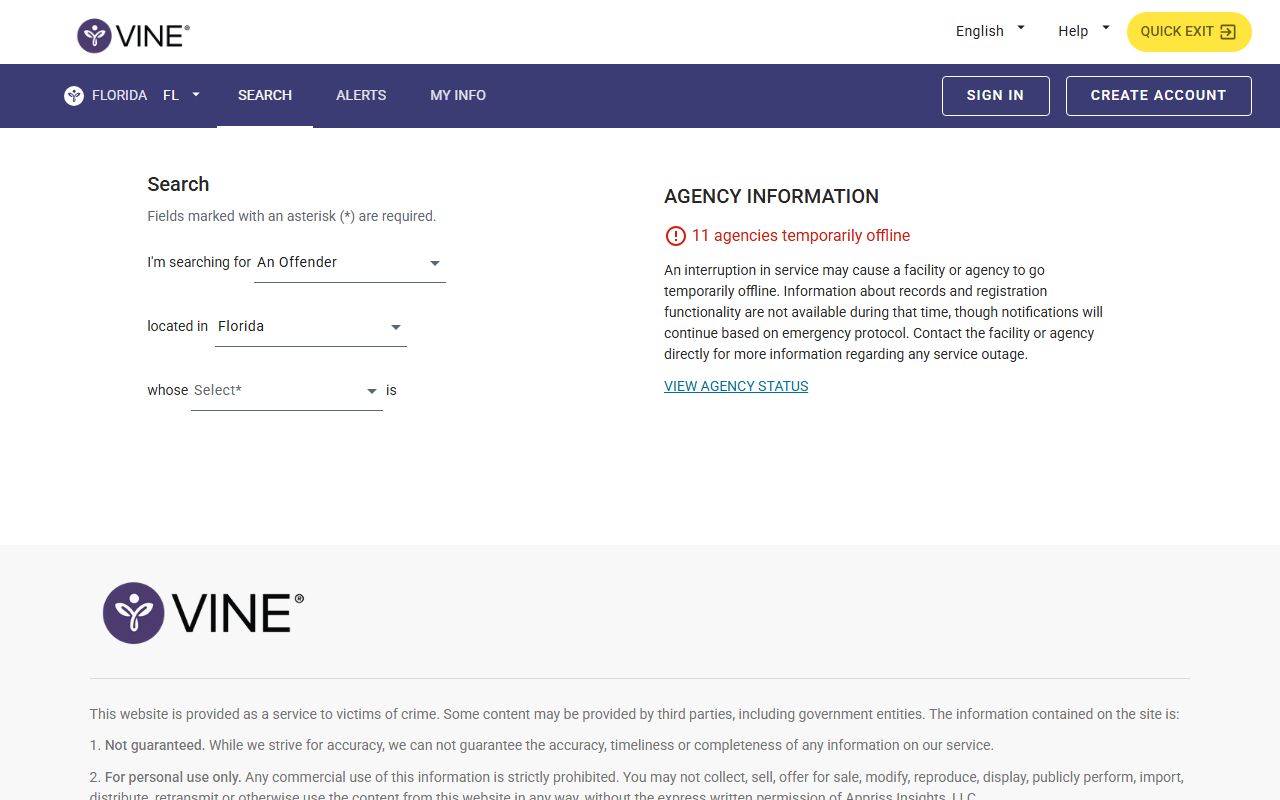
You can reach the tool at VINELink Florida. Search by state and person, then register for updates where the option appears.
Note: A notification system is only as current as the data fed into it. Always confirm a critical release through an official Corrections contact, not an alert alone.
Searching State and Federal Released Inmates (FDC + BOP)
When a sentence sends a person to state prison, the case leaves the county jail. The Florida Department of Corrections then holds the record. The FDC runs an offender search menu with several tools. Two matter most here: the Inmate Population search and the Inmate Release Information search. The first finds people now in prison. The second finds people who have been released.
The FDC release search is the right tool for a former state prisoner. The agency updates its data on a set schedule. Population data is refreshed weekly, but release dates and location changes update nightly. Release information itself is updated nightly. Escape info posts right away. Supervised and absconder data refreshes weekly, with termination dates and location changes done nightly. So a recent release should show within a day.
The FDC inmate population search is shown below.
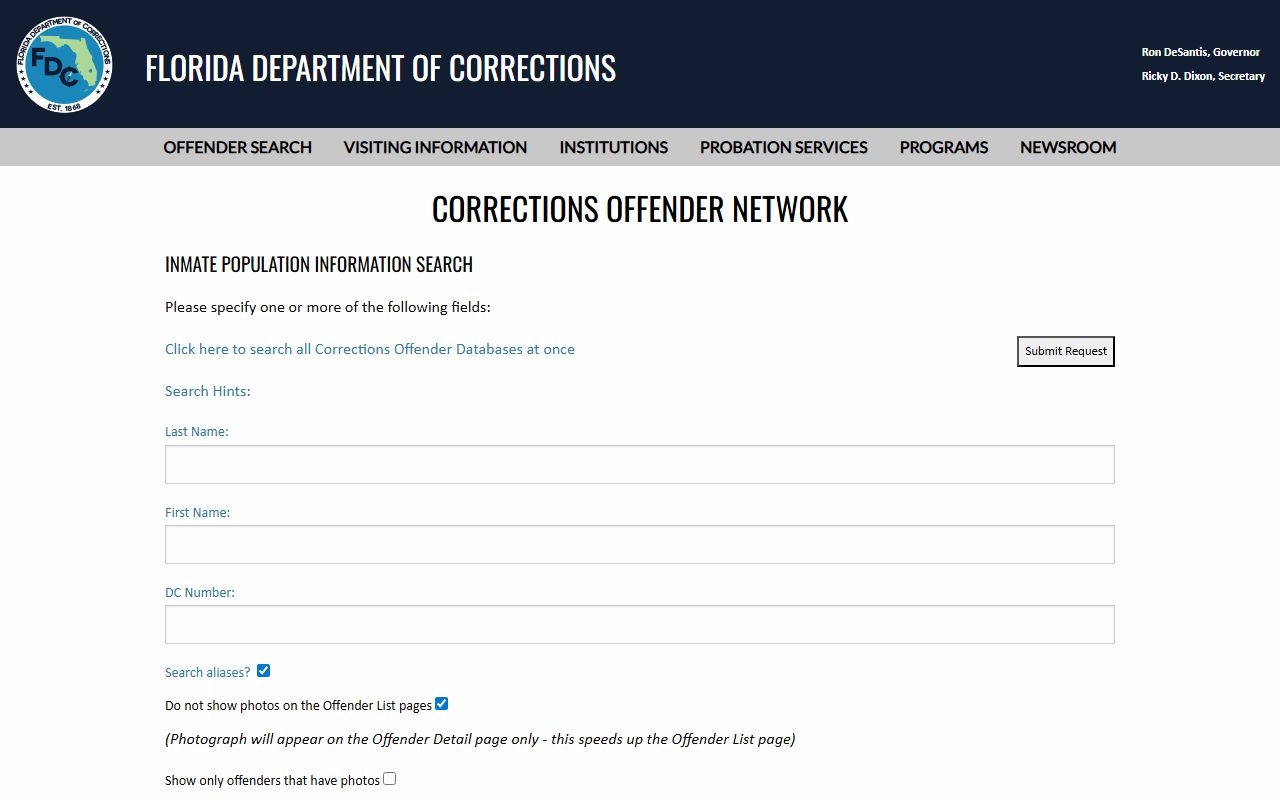
Use the FDC inmate population search to confirm a person is still in prison. To find a release, switch to the release tool. The release search page is shown below.
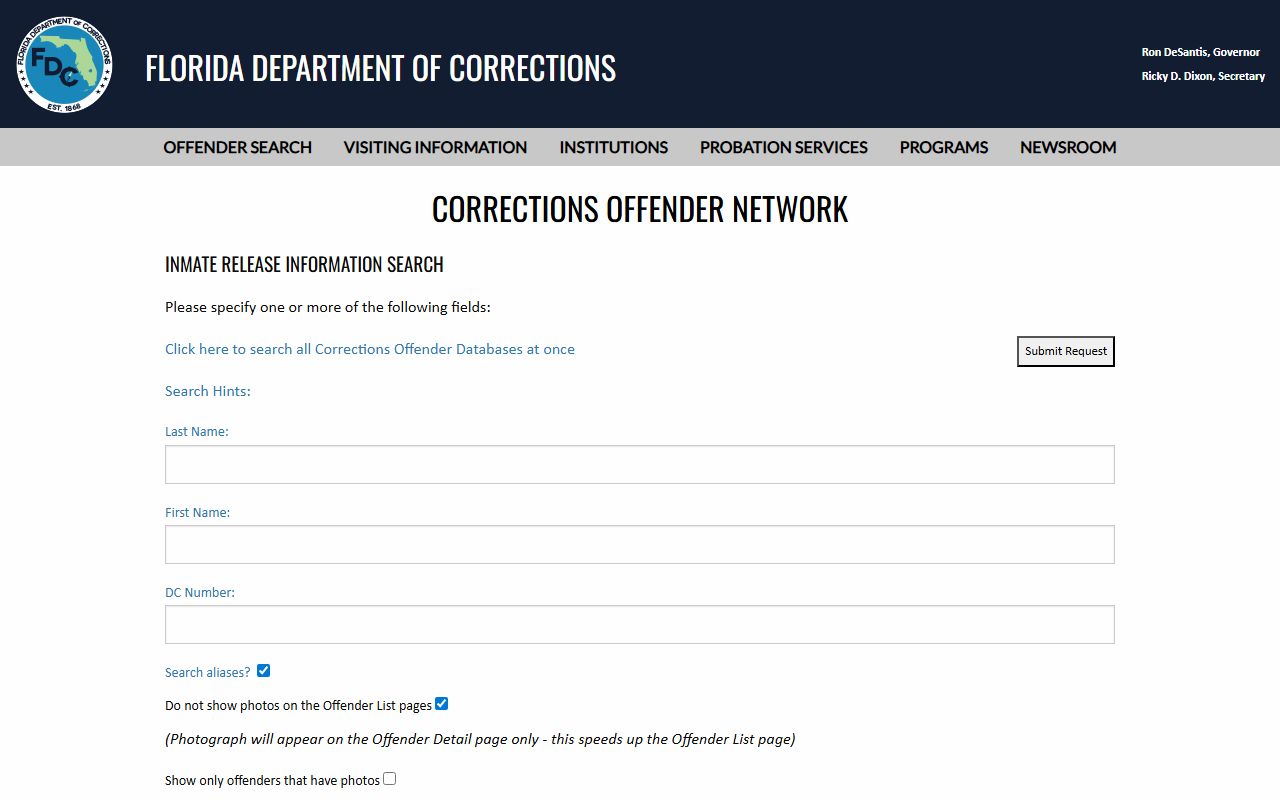
The FDC inmate release search covers people released from state prison. The full menu at the FDC offender search menu also offers escape, supervised population, and absconder tools. The release search supports a set of fields, mapped below.
| Field / Mode | Type | Notes |
|---|---|---|
| DC Number | Text | The FDC inmate number, the cleanest match for one person. |
| First / Last Name | Text | Name search; common names return many results. |
| Race / Sex | Filter | Narrows a broad name search. |
| Birth Date | Date | Helps split two people with the same name. |
| Search Type | Mode | Inmate Release Information for released state prisoners. |
Federal cases follow a different path. People held under federal charges go to the Bureau of Prisons, not the county or the state. The BOP runs its own locator. You search by number or by name. Federal records are national, so you do not need to know the facility first.
| Search Mode | Fields | Notes |
|---|---|---|
| Find By Number | BOP register, DCDC, FBI, or INS number | Pick one number type and enter the value. |
| Find By Name | First, Middle, Last | Name fields for a person search. |
| Name filters | Race, Age, Sex | Optional filters to narrow a name match. |
| Buttons | Search, Reset | Run or clear the form. |
Use the BOP Inmate Locator for any federal case. It lists current and many past federal inmates, with release dates where shown.
Verifying Release in Person or By Phone
Online tools are fast, but they lag. A release may not post the moment a person walks out. When timing matters, confirm with a live source. The county Corrections department is the authority for the local jail. They can speak to a current custody status the public roster may not yet reflect.
Call the jail information line for a county release. Have the full name and a birth date ready. A booking number helps even more. Staff will not give legal advice, and they may limit what they share by policy. But they can often confirm whether a person is still held. For a state prison release, the FDC is the right office. For a federal case, contact the BOP facility or its central locator support.
Why call at all when the search is online? Because the search drops released people at the next update, and updates run on a schedule. A phone check fills the gap between the actual release and the data refresh. It also helps when a name is common and the roster returns no clear match. For current phone numbers and hours, use the official Osceola Corrections site rather than a printed list, since contacts change.
The Sex Offender Registry
Some released people must register as sex offenders or predators. Florida keeps this in a public database run by FDLE. It is separate from the jail roster and the prison search. The registry shows people classified under state law, with public-record details on each one. Anyone can search it for free.
The FDLE registry offers more than one way to look. You can run a name search, a neighborhood search, a campus search, or an internet identifier search. Each one answers a different question. A neighborhood search shows who is registered near an address. A name search targets one person.
| Search Choice | What It Does |
|---|---|
| Offender Search | Look up a person by name and details. |
| Neighborhood Search | Find registered offenders near an address or area. |
| University/Campus Search | Find offenders linked to a college or campus. |
| Internet Identifier Search | Search by registered email or online handle. |
Read the registry rules with care. Placement in the database is not meant to show a risk level. A positive identification needs a fingerprint comparison, not just a name match. Misuse of registry information is illegal under Florida Statutes section 775.21(10)(d). For help, the FDLE Offender Registry Services Bureau runs a public line at 1-888-FL-PREDATOR.
You can reach the database through the FDLE sex offender and predator search. Use it to check a released person's registry status.
Note: The registry is for public safety information only. Using it to harass or threaten a registrant is a crime under Florida law.
Parole and Probation Information
Not every release is a clean exit. Many people leave custody onto supervision. That can mean probation, community control, or parole. Florida ended parole for most newer offenses, but it still applies to some older cases. Supervision means a person is out, yet still under court or state rules.
The FDC tracks supervised people in its own search. The Supervised Population Information Search and the Absconder/Fugitive search both sit on the FDC menu. Supervised data is refreshed weekly, with termination dates and location changes done nightly. So a person under state supervision will appear there, not on the prison population list. This matters when you find no prison record but the person is clearly out under rules.
County probation can run through the court system too. A violation can land a person back in jail. The sample county jail data even shows a probation violation statute as a booking charge. So a person on supervision can cycle back into the county roster. If you track someone on probation, the county inmate search and the FDC supervised search both help.
Reentry Resources in Osceola County
Getting out is a start, not the end. Reentry covers the help a person needs to rebuild. The Florida Department of Corrections runs reentry and probation resources for people leaving state prison. These cover the transition back to the community and the terms of any supervision.
Local self-help resources matter too. The Ninth Judicial Circuit, which serves Osceola County, posts self-help pages for people without a lawyer. The Florida Courts self-help system adds statewide forms and guides. A common reentry need is to clean up a record. People often want to seal or expunge an eligible case so it stops blocking a job or a lease.
Record sealing and expunction follow a set process in Florida. Most paths start with an eligibility review, then a petition in the local circuit court. The court self-help tools list the forms and steps. They will not file for you, and they cannot give legal advice. But they show the road clearly. For the rules on what shows up after a case closes, see the criminal records page and the FAQ.
Use the Ninth Circuit self-help page for local guides. For statewide forms on expunction, sealing, and other matters, use the Florida Courts self-help resources.
Civil Rights Restoration After Release
A felony conviction can strip certain civil rights. That includes the right to vote, to serve on a jury, and to hold some offices. After release, a person may seek to restore those rights. Florida handles this through state clemency and rights restoration rules. The process is not automatic for every case.
Voting rights have their own path in Florida. State rules tie the restoration of felony voting rights to the completion of a sentence, which can include financial obligations like fines, fees, and restitution. So a person may need to clear those terms before voting rights return. The exact rules and any required steps come from the state clemency and rights restoration system, not the county jail.
This is separate from sealing or expunging a record. Restoring rights changes what a person can do after a conviction. Sealing or expunging changes who can see the record. A person may need both, or just one. Each follows its own process. For record cleanup, the court self-help forms apply. For rights restoration, the state clemency resources are the right place to start.