
How to Search Osceola County Court Records
Court records in Osceola County are searched through the Clerk's Benchmark case search portal. The tool lets you look up circuit and county court cases in one place. You can search by name, by case number, or by citation number. Name searches use a "Last, First" format. Case-number searches follow a year, case type, and six-digit pattern, such as the tooltip example 2004 TR 000123. The portal is free to search. Certified copies and some document services cost extra.
Before you start, decide which search mode fits what you know. A case number gives the cleanest result. A name works when you do not have the number, though common names can return many matches. Citation numbers are best for traffic tickets.
The Osceola Clerk of the Circuit Court and County Comptroller runs the main records site and links out to every search tool. The screenshot below shows where these services live.
From this homepage you reach court case search, official records, marriage licenses, traffic, and probate filings. The same office supports both court divisions.
- Open the Benchmark search page at courts.osceolaclerk.com.
- Pick the radio button for Name, Case Number, or Citation Number.
- Type the search value. Use last name first for people, and the full number when you have it.
- Narrow by case type if the filter is shown. Options cover civil, family, probate, guardianship, eviction, small claims, and traffic.
- Press Search and open a case to review its docket entries.
- Order a certified copy through the eCertified link when you need a record for legal use.
Note: a screen print is not a certified record, so use the Clerk's certified copy process when a court or agency requires proof.
The Osceola County Judicial System
Florida builds its trial courts around two levels. Circuit courts are the primary trial courts. County courts handle lower-level matters. Osceola County sits in the Ninth Judicial Circuit, which it shares with Orange County. The Ninth Judicial Circuit oversees both metro and tourism-driven caseloads across the region.
The Osceola County Circuit Court hears felonies, family law, probate, guardianship, juvenile cases, and civil matters above the county limit. The Osceola County Court takes misdemeanors, traffic, small claims, evictions, and lower-value civil disputes. Appeals from the trial courts normally go to Florida's Sixth District Court of Appeal, then to the Florida Supreme Court when jurisdiction exists.
The image below shows how Florida's courts stack up.
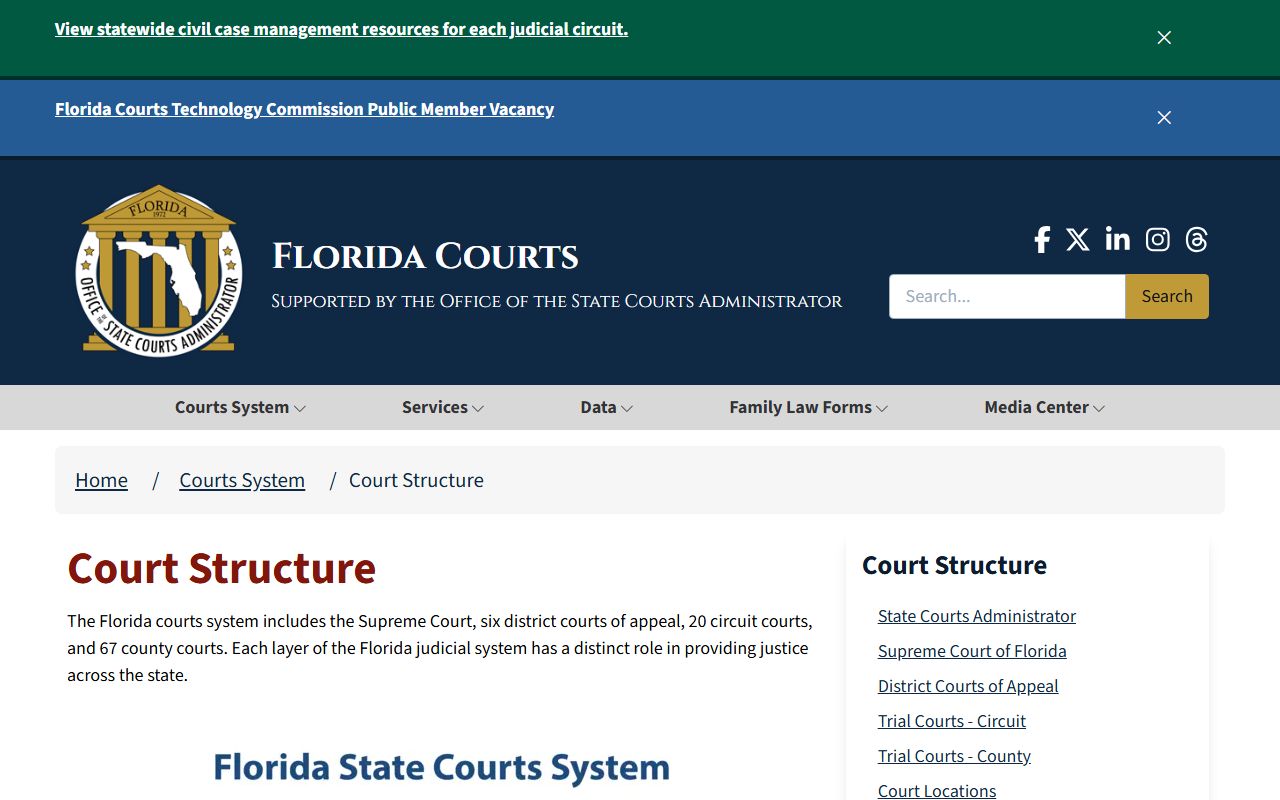
The Florida Courts overview confirms this structure statewide, which is why Osceola records route the way they do.
Case flow: County Court › Circuit Court › Sixth District Court of Appeal › Florida Supreme Court
| Court | Jurisdiction | Case Types |
|---|---|---|
| Circuit Court (Ninth Circuit) | Primary trial court | Felony, family, probate, guardianship, juvenile, high-value civil, injunctions |
| Osceola County Court | Lower trial court | Misdemeanors, traffic, small claims, evictions, county civil |
| Sixth District Court of Appeal | Intermediate appeals | Appeals from Osceola trial courts |
| Florida Supreme Court | Court of last resort | Discretionary and mandatory state review |
Types of Court Records Available in Osceola County
Osceola County court records cover many case types. Civil and criminal files make up the core. Family, probate, traffic, and small claims add more. Each level of court produces its own records, but the Clerk keeps them all in one search system.
Most of these records are public. Some are sealed, redacted, or confidential by statute. The list below shows the main groups you can find.
- Criminal records - felony and misdemeanor cases, charges, pleas, dispositions, and sentences. See Osceola County criminal records.
- Civil records - complaints, answers, motions, judgments, and writs in county and circuit civil cases.
- Family records - dissolution, paternity, child support, and injunctions. See marriage and divorce records.
- Probate records - estates, wills, guardianship, and trusts. See Osceola County probate records.
- Traffic records - citations, infractions, fines, and hearings. See traffic court records.
What Osceola County Court Records Show
An Osceola County court record holds the full story of a case. It lists who filed, what they asked for, and how the court ruled. Each docket entry marks an event, from the first filing to the final judgment. Some documents can be viewed online. Others show a restriction notice when the law limits access.
The table below breaks down the common fields you see in a case record.
| Field | What It Shows |
|---|---|
| Case Number | Year, case type, and a six-digit number, such as 2004 TR 000123 |
| Filing Date | The date the case or document was filed with the Clerk |
| Parties | Plaintiff and defendant, or petitioner and respondent |
| Charges / Cause | The crime charged or the legal claim raised |
| Docket Entries | Each filing, motion, notice, order, and hearing in date order |
| Disposition | The final outcome of the case or charge |
Sensitive items get redacted. Social Security numbers, account numbers, victim details, and minor information do not appear in the public view.
Public Access Laws for Osceola County Court Records
Florida law starts from a simple rule. Public records are open. Article I, Section 24 of the Florida Constitution grants the right of access. Chapter 119 of the Florida Statutes spells out how it works. Court records also follow Rule 2.420 of the judicial branch. The Clerk acts as the records custodian, but court rules and statutes still limit some categories.
Public means you can inspect and copy a record. It does not mean every image sits online for download. Exempt means a custodian can or must withhold part of a record. Confidential means stronger limits set by law.
Key Statutes:
Fla. Stat. § 119.01 - declares the state policy that public records are open for inspection and copying.
Fla. Stat. § 119.07 - requires custodians to allow inspection and copying and sets response and fee rules.
Fla. Stat. § 119.071 - lists general exemptions, including protected personal information.
Fla. Stat. § 119.0714 - covers court files and confidentiality of certain court-file information.
Fla. Stat. § 28.24 - sets the Clerk's charges for copies, certifications, and recording.
Note: if a request is denied, ask for the statutory basis and whether a redacted copy can still be produced.
Records That Are Restricted or Confidential
Not every Osceola County court record is open. Florida law shields some files to protect people and ongoing matters. Juvenile delinquency and dependency records are limited under Fla. Stat. § 985.045. Adoption records are confidential under Fla. Stat. § 63.162. Mental health clinical records fall under Fla. Stat. § 394.4615.
Sealed and expunged criminal records follow Fla. Stat. § 943.059 and Fla. Stat. § 943.0585. Sealing hides a record from general public view but keeps it for authorized agencies. Expunction goes further and removes qualifying records. To seal or expunge, most people get an FDLE eligibility review, file a petition in the Ninth Circuit, serve the required agencies, and wait for a judge's order. Eligibility is technical, so use official forms or a lawyer.
Specialty Courts in Osceola County
The Ninth Judicial Circuit runs problem-solving courts that work as supervised programs, not separate record offices. Their case files stay in the underlying criminal or family case unless the law makes them confidential. These dockets focus on treatment and accountability rather than a quick disposition.
Drug court handles cases driven by substance use. It uses screening, treatment, testing, supervision, and graduated sanctions. Veterans court serves eligible veterans and often pairs court monitoring with VA and community support. Mental health court routes qualifying defendants into monitored treatment plans, while medical details stay protected.
- Drug court - treatment, testing, and compliance reviews.
- Veterans court - monitoring with veteran services and mentoring.
- Mental health court - supervised treatment for qualifying defendants.
Eligibility depends on the charge, a risk and needs review, prosecutor approval, and the judge. Anyone interested should contact the court or an attorney to confirm options.
Osceola County Sheriff and Jail Information
Osceola County corrections records come from the county Corrections Department, not only the Sheriff. The county publishes a current inmate population search, daily arrest reports, and a daily population statistics file. The current inmate page noted 882 people in custody when checked on May 19, 2026. Inclusion does not mean guilt. The data updates several times a day, and released people drop off at the next update.
The page below is the main hub for jail and corrections services.
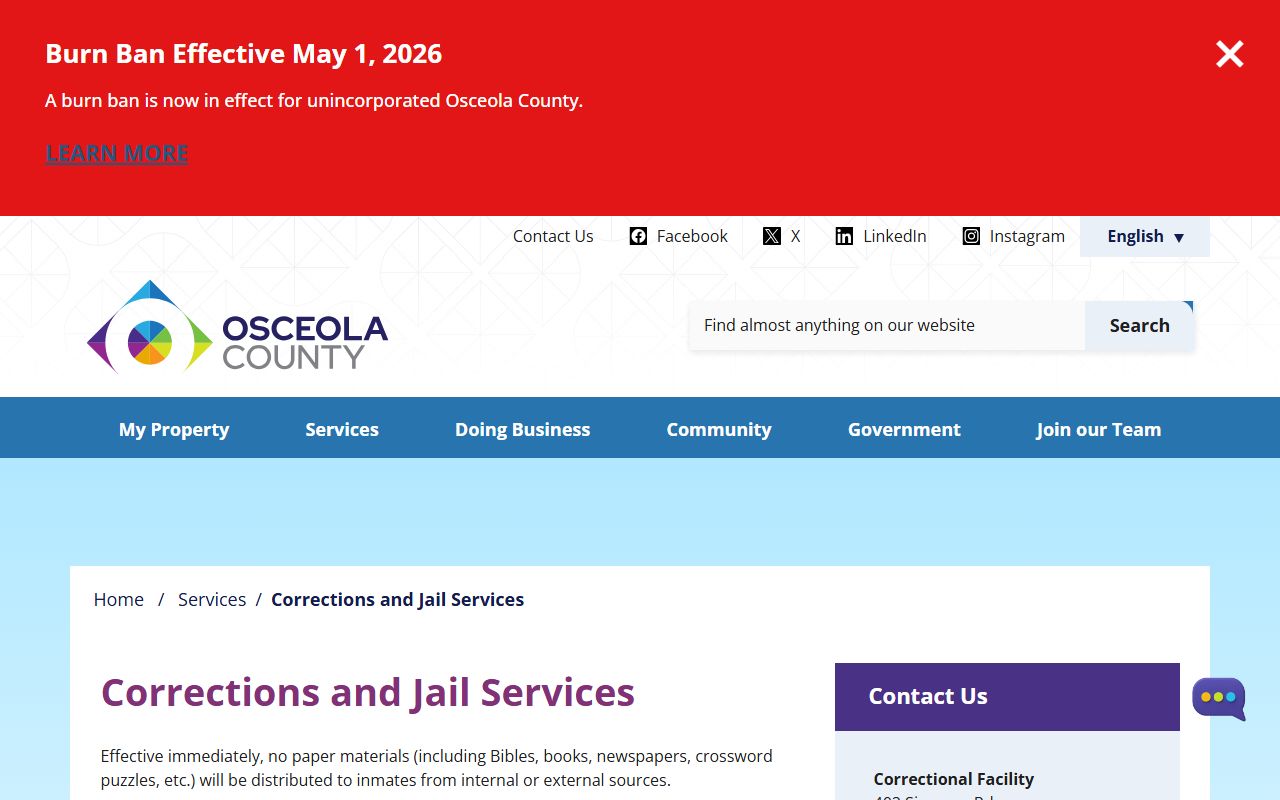
From the Corrections and Jail Services page you reach the roster and reports. For full roster detail, see Osceola County inmate records. For active warrant questions, see warrant records. The Osceola County Sheriff's Office handles arrests in the field.
Marriage, Divorce, and Probate Records
The Clerk issues marriage licenses and keeps divorce and probate files. Divorce dockets are generally public, but financial and minor details get redacted. Probate runs as a division of the circuit court. For more, see marriage and divorce records and Osceola County probate records.
- Testator
- The person who makes a will.
- Executor
- The person named to carry out a will.
- Intestate
- Dying without a valid will.
- Guardianship
- A court appointment to manage a person's care or property.
Osceola County Court Case Search Fields
The Benchmark portal exposes a few main fields. Knowing them up front makes the search faster. The table maps each field to its type and use.
| Field Label | Type | Required | Notes / Format |
|---|---|---|---|
| Name | Radio + text | One mode required | Enter Last, First. Party name search. |
| Case Number | Radio + text | One mode required | Year, case type, six digits. Example 2004 TR 000123. |
| Citation Number | Radio + text | One mode required | Best for traffic tickets. |
| Case Types | Multi-select | Optional | Civil, family, probate, guardianship, eviction, small claims, traffic. |
Osceola County Court Records Fees
The Clerk charges fees for copies and certifications. Florida sets many of these under Fla. Stat. § 28.24. Recording taxes and service charges can apply on top. Exact dollar totals can change, so confirm current rates on the Clerk fee page before you pay. The table groups the common charge categories.
| Item | Source |
|---|---|
| Plain copies | Clerk fee schedule under § 28.24 |
| Certified copies | Clerk certification fee; eCertified option online |
| Recording fees | § 28.24 plus documentary stamp and recording taxes |
| Court filing fees | Statutory filing fees plus local service charges |
How to Interpret Osceola County Court Records
Court records use shorthand that can confuse a first-time reader. A charge is not a conviction. A charge is what the state accuses. A conviction is a finding or plea of guilt. The disposition tells you the final result. Common entries include dismissed, guilty, not guilty, and nolle prosse.
Watch the difference between two dismissal types. Dismissed with prejudice ends the case for good. Dismissed without prejudice lets the state refile. A capias is an arrest writ, often for failing to appear. When a docket abbreviation is unclear, the Clerk can explain the code, though staff cannot give legal advice.
Accuracy and Record Limitations
Online records can lag behind the courthouse. New filings take time to post. Old or archived cases may not appear at all, and some need clerk-assisted retrieval. Sealed and restricted files stay off the public portal by design.
Note: Confirm any detail with the originating Clerk or court division before you rely on an online record for a legal or financial decision.
History of Osceola County Courts
Kissimmee is the county seat, and the courthouse square anchors the county's court identity. Florida's modern structure places Osceola in the Ninth Judicial Circuit with Orange County. The county's case mix reflects steady population growth, tourism, and busy transportation corridors. That means heavy volume in traffic, landlord-tenant, family, criminal, and probate matters.
Technology has reshaped access. Court files are searchable through Benchmark. Official records use a browser-based portal with eCertified copy ordering. Statewide e-filing runs through the Florida Courts ePortal. Corrections posts current population data and daily arrest reports with downloadable files.
Osceola County Courthouse Location
The main destination for hearings and records is the courthouse in downtown Kissimmee. It houses circuit and county court functions and routes civil, criminal, family, probate, and traffic matters through the unified Clerk. Bring a government ID for many clerk and court services, and expect weapons screening at entry.
Phone numbers vary by division, so use the Clerk and Ninth Circuit contact pages for current routing. For office details, see the Clerk of Court page.
Self-Help and Legal Aid Resources
Many people handle court matters without a lawyer. Florida and the Ninth Circuit publish forms and guidance for common needs. Clerk staff can give forms and procedural help, but they cannot give legal advice.
Use the Ninth Circuit self-help resources and the Florida Courts self-help page for divorce, small claims, eviction, name change, probate, guardianship, and injunction topics. For e-filing, use the Florida Courts ePortal. Criminal defendants who cannot afford counsel apply through the court for a Public Defender.
Free civil legal help for Osceola County residents is also available through these organizations:
- Community Legal Services of Mid-Florida - serves Osceola among 12 Central Florida counties. Intake line 800-405-1417.
- Legal Aid Society of the Orange County Bar Association - serves Brevard, Orange, Osceola, and Seminole. Intake line 407-841-8310.
- Florida Legal Services - statewide nonprofit handling impact and complex civil cases.
- Florida Law Help - statewide directory to find a provider by issue and county.
Frequently Asked Questions
How do I search Osceola County court records?
Use the Clerk's Benchmark search. Pick Name, Case Number, or Citation Number, type the value, and press Search. Case number is the cleanest method when you know it. The case-number tooltip gives the example format 2004 TR 000123. More detail sits on the court records page.
What court system is Osceola County in?
Osceola County is in Florida's Ninth Judicial Circuit with Orange County. The circuit court handles felony, family, probate, guardianship, and larger civil cases. The county court handles misdemeanors, traffic, small claims, and evictions.
How current is the inmate search?
The county states the inmate search updates several times per day. When someone is released, they drop off at the next update. See inmate records for the full roster and search steps.
More answers sit on the Osceola County Court Records FAQ page.