
How to Search Osceola County Marriage and Divorce Records
Marriage and divorce records sit in two different places. Marriage records are recorded by the Clerk in official records. Divorce cases are court files in the circuit court. Both run through the same Osceola Clerk office, but you search them with different tools.
For a divorce, use the Clerk's Benchmark court case search. It lets you look up a case by name or by case number. A name search uses a Last, First format. The case number is the cleanest path when you have it. For a marriage record, use the Clerk's official records search and look by party name. Knowing which tool to pick saves time.
- Divorce case - search Benchmark by name or case number.
- Marriage record - search official records by party name.
- Certified copy - order from the Clerk after you find the file.
If a record will not show, the file may be old, sealed, or not yet entered. Contact the Clerk when an online search comes up empty.
Applying for an Osceola County Marriage License
A marriage license is the legal go-ahead to marry. In Florida, the Clerk issues it. Osceola County couples apply through the Osceola Clerk office. The general flow is set by state law, including Fla. Stat. § 741.04, which covers license issuance. Confirm the current steps and ID rules with the Clerk before you go.
- Confirm eligibility and ID rules with the Osceola Clerk.
- Apply for a Florida marriage license through the Clerk.
- Pay the license fee at the time you apply.
- Observe any waiting period that Florida law applies.
- Have an authorized officiant perform the ceremony.
- Return the executed license to the Clerk for recording.
- Request certified copies from the Clerk once it is recorded.
Florida law allows a fee or waiting-period benefit for couples who finish an approved premarital prep course. The exact local amount can change, so ask the Clerk for the current figure. The marriage license statute is shown below.
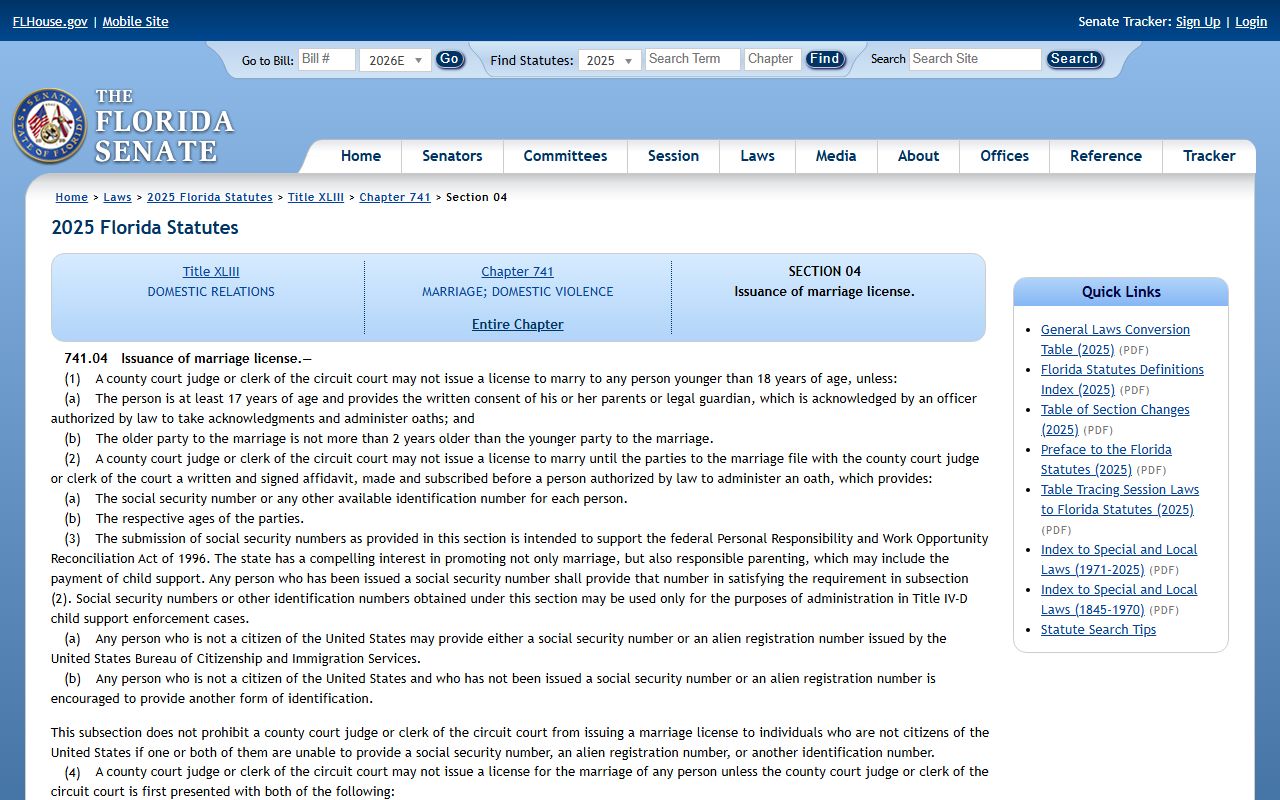
The text on the marriage license statute page sets the base rule for issuing a license in Florida.
Marriage License Requirements
Both partners take part in the application. Each person should bring valid ID. The Clerk asks for basic details about each applicant and any prior marriages. The table below is a step and item inventory you can use to plan the visit. Confirm the exact ID list with the Clerk, since rules can shift.
| Item / Step | Notes |
|---|---|
| Valid photo ID | Each applicant brings a government-issued ID. Confirm accepted types with the Clerk. |
| Social Security data | Florida applications request SSN information for applicants who have one. |
| Prior marriage details | State if either party was married before, and how it ended. |
| Both applicants present | Apply together through the Osceola Clerk. Confirm any absent-party rules. |
| License fee | Pay at application. A premarital course may lower the fee or waiting period. |
| Premarital course (optional) | An approved course can grant a fee or waiting-period benefit under Florida law. |
| Officiant for ceremony | Line up an authorized officiant to perform and sign the license. |
Once issued, the license is valid for a set window under state law. The ceremony must happen inside that window, or the license can lapse.
Note: A marriage license and a marriage certificate are not the same. The license lets you marry. The recorded certificate proves the marriage took place.
Marriage License Fees
The Clerk charges a fee to issue a marriage license. Florida sets many clerk charges under Fla. Stat. § 28.24, and the license itself ties to Fla. Stat. § 741.04. Exact local totals can change and may include service charges, so check the current Clerk fee page before you pay. The table groups the common charges by category rather than listing a dollar figure.
| Charge Category | Source |
|---|---|
| Marriage license fee | Set under § 741.04 and the Clerk fee schedule. |
| Premarital course reduction | Approved course may lower the fee or waiting period under Florida law. |
| Certified copy of marriage record | Clerk certification fee under § 28.24. |
| Recording charges | § 28.24 plus any service charges where authorized. |
Pay the fee when you apply. The Clerk takes payment at that time. For the current amount, the Clerk fee page is the only reliable source.
Searching Divorce Records
Divorce in Florida is called dissolution of marriage. The case is filed in the circuit court. To find one, use the Clerk's Benchmark court case search. You can look by party name or by case number. The Benchmark case-type list groups these cases under a few labels.
Three dissolution case types show in Benchmark. Pick the filter that fits if the form allows it.
- Dissolution of Marriage - a divorce with no minor children involved.
- Dissolution of Marriage W/Children - a divorce that involves minor children.
- Simplified Dissolution - a streamlined path for couples who both agree and qualify.
A name search uses Last, First. If two people share a name, the case number removes doubt. Open a case to see the docket, the parties, and the final result. You can search court cases on the Benchmark portal for free. For broader court file help, see the court records page.
Filing for Divorce in Osceola County
You file a divorce with the Clerk in the circuit court. Before you start, you must meet the Florida residency rule. Fla. Stat. § 61.021 requires that one party live in the state for the set period before filing. The steps below outline the path. They are general, not legal advice, so a self-help center or attorney can help with current forms.
- Meet the residency requirement under § 61.021.
- Choose the right dissolution packet: simplified, with children, or without children.
- File the petition with the Clerk in the circuit court.
- Pay the filing fee, or submit a civil indigency or fee waiver application if you qualify.
- Serve the other party, unless the filing is joint or service is waived by procedure.
- Complete parenting, financial disclosure, mediation, and hearing steps as ordered.
- Obtain the final judgment, then request certified copies from the Clerk.
Cases with children add steps, like a parenting plan and a parenting course. The residency statute is shown below.
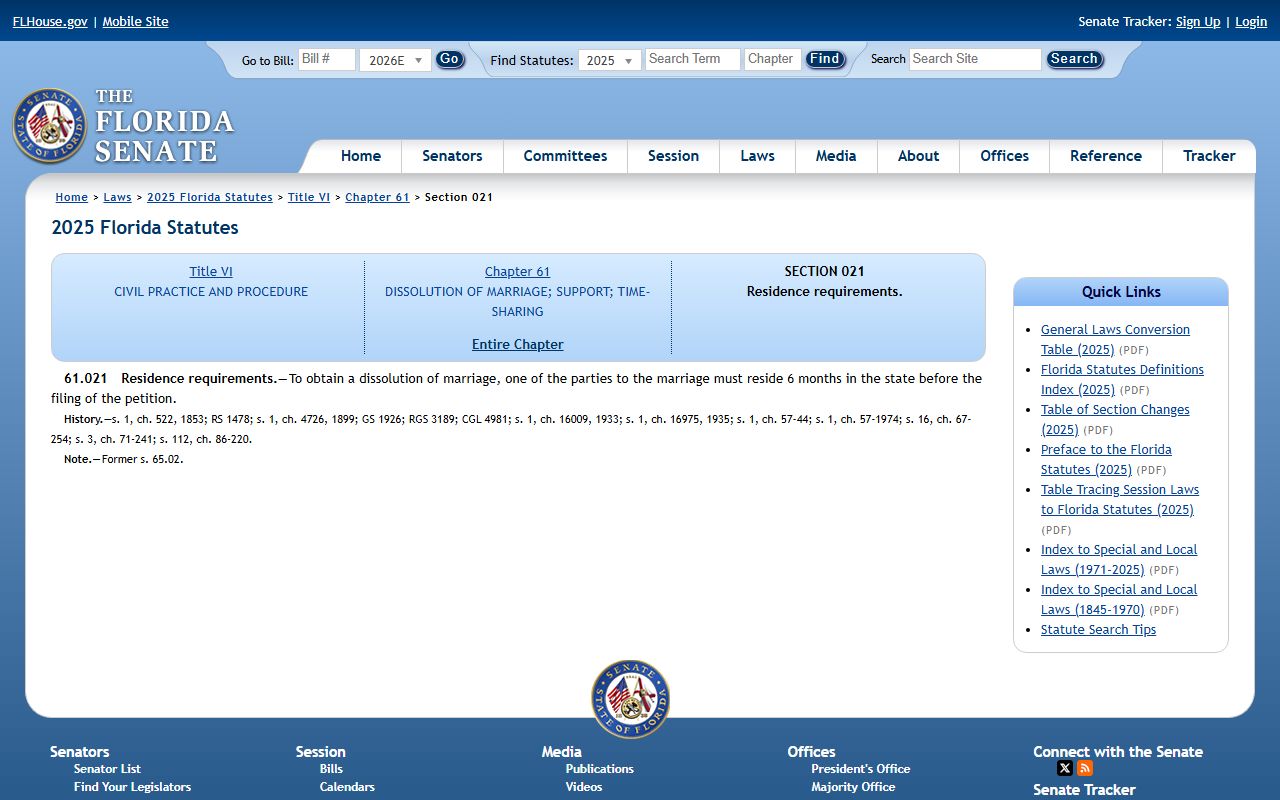
The residency statute sets how long you must live in Florida before you can file.
What Divorce Records Show and What Is Redacted
A divorce file tells the case story. It names both parties. It lists each filing in date order. It records the final judgment that ends the marriage. Cases with children may show a parenting plan and support terms. Most of this docket is open to the public.
Not every detail is open, though. Florida law and court rules protect sensitive data. The Clerk redacts the protected parts before public view. The table below maps what a divorce record commonly shows and what is held back.
| Field | Public or Redacted |
|---|---|
| Party names | Public on the docket |
| Case number and filing date | Public |
| Docket entries and final judgment | Public, with sealed items withheld |
| Social Security numbers | Redacted |
| Financial account numbers | Redacted |
| Minor children information | Protected and limited |
| Abuse or victim details | Redacted |
| Sealed filings | Not shown to the public |
So the docket is public, but the private numbers are not. For more on what stays confidential, see the public records page.
Certified Copies of Marriage and Divorce Records
A screen print is not proof. For legal use, you need a certified copy from the Clerk. The Clerk attests to it with a seal. Many name changes, benefits claims, and immigration steps ask for one. You can order online or at the courthouse.
The Clerk offers an eCertify option for official records. You pick the document, pay the fee, and get a certified copy. The certification fee falls under Fla. Stat. § 28.24. The courthouse where these records are handled appears on the map below.

You can order certified records through the Clerk's eCertify site. A divorce final judgment copy comes from the court case file, while a recorded marriage copy comes from official records.
Note: The certified copy fee is higher than a plain copy fee. The Clerk charges more because the office attests to the document.
State Vital Records vs Court Records
People often mix up two systems. The Florida Department of Health keeps statewide vital records. The county Clerk keeps the local court files and recorded documents. They overlap, but they are not the same source.
For an Osceola County divorce case, the Clerk holds the court file and the final judgment. For a marriage that the Clerk issued and recorded, the local official records hold the recorded copy. The state health department also keeps marriage and dissolution report data at the state level. If you need a state-level certificate, you may turn to the state office. If you need the actual court case or the locally recorded license, the Clerk is the place to go. Pick the source based on what document you must produce and who asks for it.